
I met Christa Schroeder in a hotel hallway in DC.
She recognized me from a Facebook group we were both in. We'd never actually talked. She introduced herself, it was brief, and we went our separate ways.
Months later she was on my email list. When I mentioned PodGlue, she reached out. We jumped on a call. And what happened in that conversation is exactly why I keep having these conversations.
Christa runs a podcast in Pender County, North Carolina. She started by interviewing local business owners. The idea was to connect longtime locals with new arrivals, and give tourists a reason to look beyond the beach. Smart concept. Real community need.
But the numbers weren't moving.
Long-form audio podcasting reaches people who like long-form audio podcasting. That's not most people. Meanwhile, short-form video was getting saturated. So Christa made a call: pivot. Stop doing what wasn't working. Start something that fits the community she actually wanted to serve.
Her new direction? Civic issues. Housing. Zoning. Local government. Give the people of Pender County a real platform, not left or right, just the issues affecting their daily lives.
And that's when she realized she had a problem she hadn't anticipated.
When you're interviewing a local business owner, the relationship is pretty simple. You talk, you publish, you move on. But when you're sitting across from a county commissioner, a state assemblyman, a local planner, you need to know who that person is before they walk into the room.
What have they said publicly? What positions have they taken? What did they talk about on the three other podcasts they've been on?
That's a research problem. And it's one most podcast tools don't even acknowledge exists.
I told her about the way I think about PodGlue: like an IMDb for podcasts. You pull up a person's name and you see every show they've been on, what topics came up, what they've said before. Not just your episodes. All of them.
Her reaction was immediate. That's exactly what I need now.
The timing wasn't coincidental. It was just that her use case had finally caught up to why the tool was built.
Here's the thing I've been saying for a while, and every conversation I have reinforces it.
The episode is not the product.
I know that sounds backwards. The whole point of a podcast is to make episodes, right? That's the deliverable. You record, you edit, you publish, you promote.
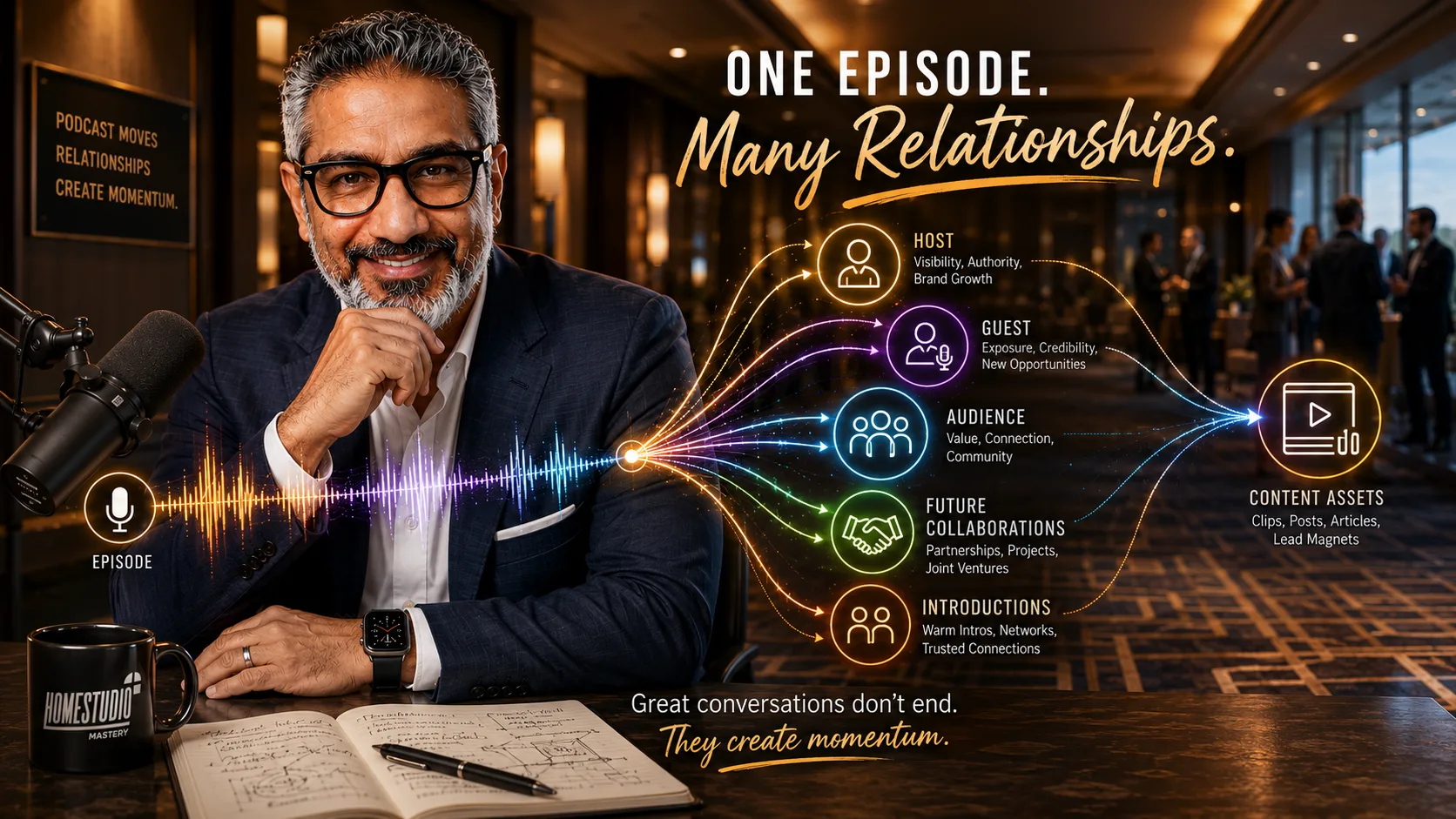
But what you're actually building, if you're doing this right, is a relationship with the person on the other side of the microphone. The episode is just the proof that the conversation happened. The relationship is what compounds.
Christa's civic journalism pivot is a perfect example. She's not trying to make viral content. She's trying to build a record. A living document of what the people shaping her county have said, believe, and committed to. The episodes are the receipts. The relationship is the accountability structure.
That's a different way to think about a podcast. And it changes everything: what you ask, how you follow up, what you do after you hit publish.
We talked about a few other things on that call.
The social content lab inside PodGlue: how it pulls LinkedIn posts, event copy, and promotional content directly from the transcript. No rewriting from scratch every time. You did the conversation. Let the system do the rest.
We talked about turning podcast transcripts into book chapters. Christa's been at this long enough that she has a real archive. That archive is a manuscript waiting to be assembled. It's already written, just not in that shape yet.
And we talked about the PRM concept, podcast relationship management, the idea that the conversation doesn't end when the recording does. It starts there. Where it goes after is the part most podcasters are leaving on the table.
I keep saying this and I'll keep saying it: most podcasters are sitting on something way more valuable than a content library.
They're sitting on a relationship network. Hundreds of people who said yes to a conversation. People who trusted them enough to show up, talk for an hour, be honest about something.
That's not a back catalogue. That's a community. And most of us don't treat it like one.
Christa figured this out not because she read a framework or watched a video about it. She figured it out because she changed what she was trying to do with her show, and suddenly the gap between what podcasting gives you and what it could give you became impossible to ignore.
That's the moment. Not the launch. Not hitting a download milestone. That moment when you realize the conversations were the thing all along.
PodGlue is built for what happens after the recording stops. If you're doing work that matters (civic journalism, community building, thought leadership, anything where the relationship has a longer arc than the episode) it's worth looking at. It's in beta now.