
I've been doing AV for 30 years. I've helped hundreds of people set up home studios: podcasters, coaches, consultants, speakers. And I keep seeing the same gap, over and over.
It's not the camera. It's not the microphone. It's not the background.
It's a single light. A small one. Positioned behind you.
Most people don't even know it exists.
What a Hair Light Is
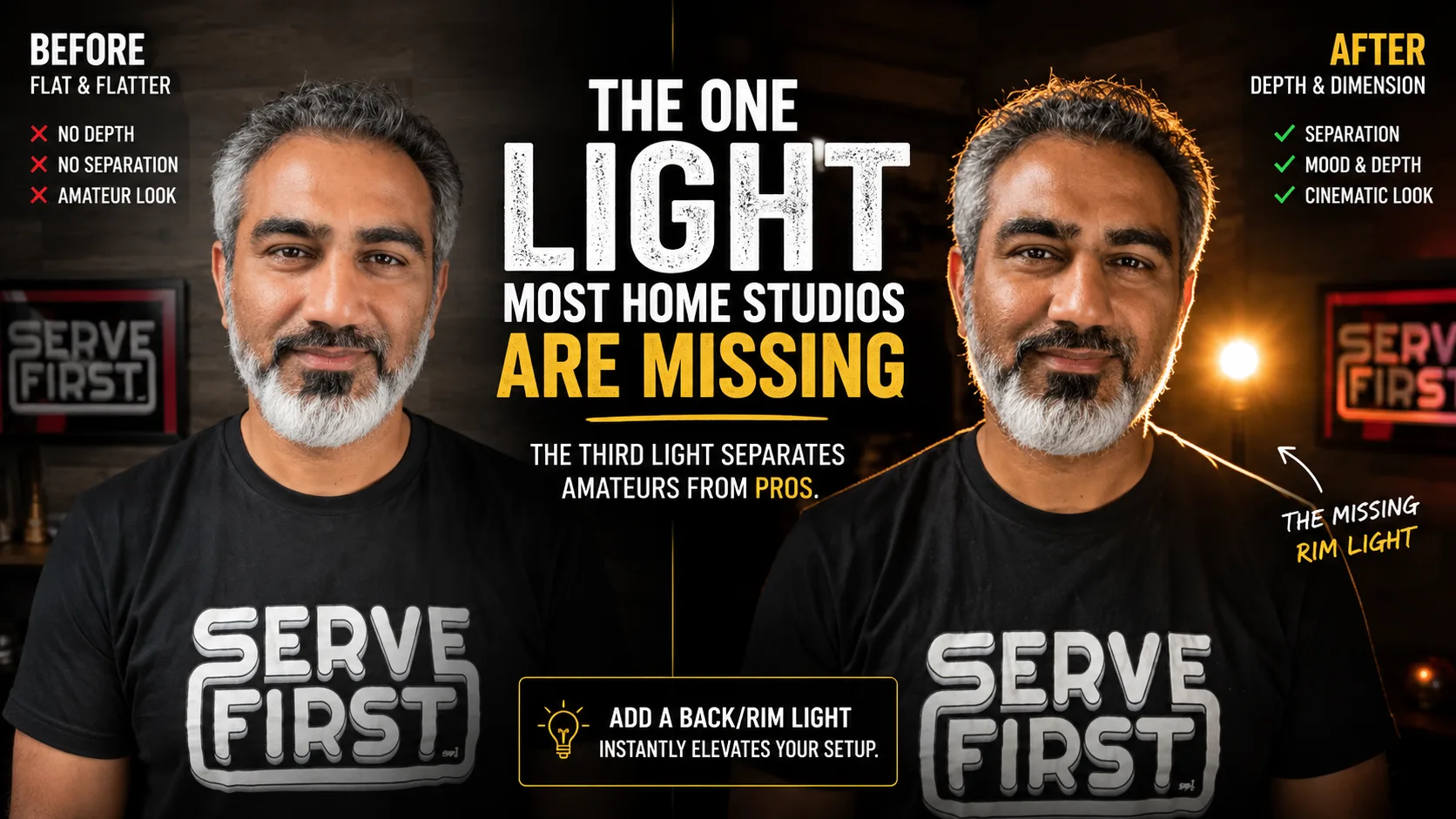
A hair light, also called a separation light or a rim light, is a small light positioned behind and slightly above you, aimed at the back of your head and shoulders.
That's it. That's the whole thing.
What it does is create a thin rim of light along your edges. Your hair, your shoulders, the outline of your silhouette. It separates you from whatever's behind you. It gives the camera something to grab onto.
Without it, you blend into the background. With it, you pop.
Why Nobody Tells You About It
People buy a ring light. Or two softboxes. They point them at their face, get their key light dialed in, maybe add a fill, and call it done.
And that's fine. Front lighting matters. But that's only half the equation.
The third light, the one behind you, is what TV and film sets have always used. It's standard on every professional production. That's a big part of why broadcast video looks the way it does. That "polished" look people are chasing isn't just a better camera. It's a separation light doing its job.
Nobody in the home studio world talks about it because the conversation always starts and ends with "what do I point at my face."
The Shameika Moment
A few weeks ago I was on a call with Shameika Rhymes. Former TV news anchor. Reporter with over 20 years of on-camera experience. She knows what professional video looks like. She spent two decades living it.
She had good lighting. Really good, actually. Proper key light, clean setup. But when I looked at her on camera, something was off.
Her shoulders were dissolving into the wall behind her. The background and her body were fighting for the same tonal value. She looked flat. Muted. Like the image had no depth.
So I showed her my setup.
Hair light off: I blended right into the wall behind me. You could see my shoulders disappear into the background.
Hair light on: clean edge. Instant separation. I lifted right off.
She saw it immediately. Didn't take 30 seconds of explanation. Just: oh.
That's how obvious it is once you know what you're looking for. And that's someone who spent 20 years in front of a camera. She'd never had a separation light in her home setup.
What It Looks Like Without One
Your body and your background compete for the same visual space. They share similar tonal values, meaning the camera can't easily tell where you end and the wall begins.
You look flat. Two-dimensional. Compressed into the frame.
People assume this is a camera problem. They upgrade to a mirrorless and wonder why they still don't look "professional." Some think it's the lens. Some think it's their compression settings.
It's usually the light.
What It Looks Like With One
Depth. Immediate, visible depth.
Your silhouette has a defined edge. The subject and the background are clearly distinct. The image has dimension.
This is the difference between a setup that looks like a Zoom call and one that looks like a production, even if the front lighting is identical. Same ring light, same softbox, same camera. Add the separation light and the whole thing changes.
The Practical Setup
You don't need anything expensive.
A small LED panel. A stand. Positioned behind you, slightly to one side, angled toward the back of your head and shoulders. A $30 panel makes a visible difference. A $60 panel looks great.
The goal isn't to blow out your background or create a dramatic effect. You're not going for a music video. You just want enough light on your edges to give the camera something to separate you from whatever's behind you.
Set it up, turn it on, look at the difference. You'll see it in 10 seconds.
The Bigger Point
You don't need more lights. You need the right lights in the right places.
Most home studios are over-invested in front lighting and completely missing the one light that gives the whole setup dimension. It's not about buying more gear. It's about understanding what each light is supposed to do, and realizing you're missing one.
The hair light is the highest-impact upgrade most home studio creators haven't made yet. Not because it's hard. Because nobody told them it existed.
If you're setting up or improving a home studio and want to get this right without spending the next six months figuring it out piece by piece: that's exactly what Home Studio Mastery covers. Reach out if you want to talk through your specific setup.