
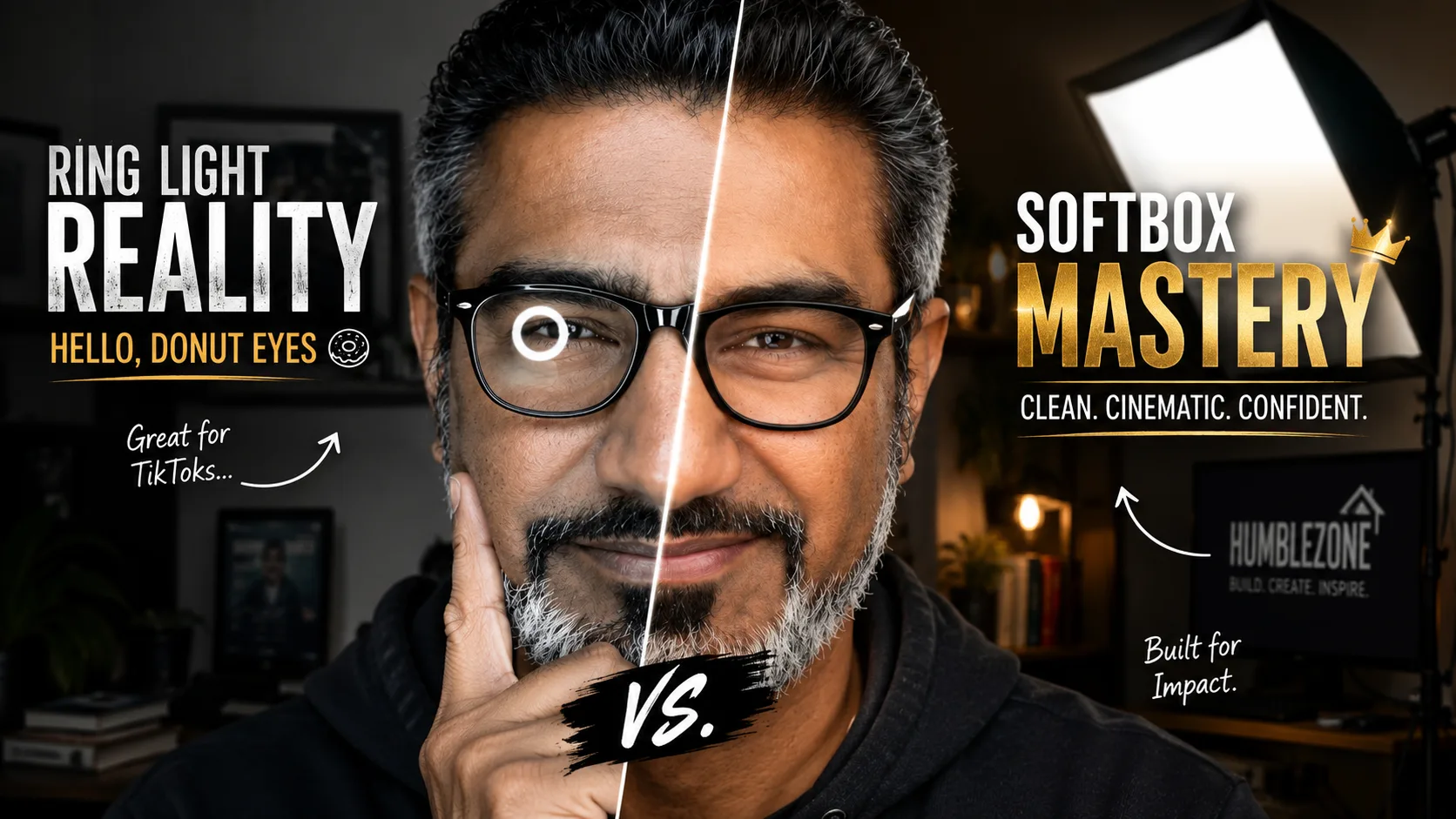
I've been in AV for thirty years. I've helped hundreds of people set up home studios: cameras, mics, acoustics, lighting.
The single most common piece of lighting equipment I see: a ring light.
The single most common lighting mistake I see: that same ring light used as the primary, sometimes only, light source for video.
I understand why. Ring lights are everywhere. They're cheap, they're easy, they're portable. You see them on Amazon, you see them in every influencer's background. They feel like the obvious choice.
They're the wrong choice. Here's why.
Ring Lights Were Designed for One Thing
Beauty content. Makeup tutorials. Product reviews filmed at arm's length.
The whole point of a ring light is even, wrap-around illumination that eliminates shadows. When you're filming a skincare routine from twelve inches away, that's exactly what you want. Smooth, flattering, no harsh shadows on the face. Even a small blemish disappears under that wash of light.
That's the job. Ring lights are good at that job.
The problem is when you take a tool designed for one specific purpose and try to use it for something else entirely.
What Ring Lights Do to Your Video
A ring light is a single, flat light source. Centered on the lens. It surrounds the camera and floods the subject with even light from every direction at once.
That means no shadow.
Here's the thing most people don't realize: shadow is how the human eye reads depth. Shadow creates contour. Contour creates dimension. Dimension is what makes a face look three-dimensional on a two-dimensional screen.
No shadow means no depth. No depth means a flat face. A flat face means an amateur image, even if everything else is technically well-lit.
There's also the catchlight. The catchlight is the reflection of your light source in your subject's eye. With a ring light, it's a perfect circle. Anyone who's spent time in video production sees it immediately. It's not subtle. The moment someone sees that ring in your eyes, they know exactly what you're using, and what you're not.
What Broadcast Uses Instead
Panel lights. LED panels with diffusers. Softboxes.
And a specific arrangement: a key light at roughly 45 degrees from the subject's face, positioned slightly above eye level. Then a fill light on the opposite side, lower intensity, to soften the shadows the key light creates without eliminating them completely.
This is the basic three-point lighting setup that broadcast and film have used for decades. You've seen it your whole life without knowing what you were looking at. It's the setup that makes people look natural on camera, the way your eye naturally reads a face in real light.
The key light does the work. The fill light keeps the shadows from going too dark. The result is dimension. Your face has depth. You look like you belong on camera.
The Setup for a Home Studio
Two lights. That's it.
A medium-sized LED panel as your key light: positioned at 45 degrees to your face, slightly above eye level, aimed down toward you. This is your main light. It does the heavy lifting.
A smaller or lower-powered panel on the opposite side as your fill. Not as bright. Not competing with the key. Just softening the shadows so they don't go too deep.
That's the whole setup. You don't need anything else to get a professional image.
And here's what surprises most people: a decent two-panel setup often costs less than a quality ring light. You get a better result for the same money, or less.
When Ring Lights Are Fine
Short-form mobile content. You need to shoot something fast, you're in a hotel room, you want even light and portability. A ring light is fine for that. Get it done.
But if you're building a studio setup for a podcast, for LinkedIn video, for corporate presentations, for any long-form content where you're trying to establish credibility, panel lights are the right tool. Ring lights are not.
The tool has to match the job.
LeAnn's Setup
LeAnn Lyon came to me with two ring lights. Her image was bright. Really bright. She had clearly invested in lighting.
But something felt off. Her face and her background had the same tonal value. Everything was equally lit. There was no separation, no depth, no dimension. She looked like she was pasted onto the background rather than existing in the same space as it.
When I explained the 45-degree key light principle, that you want to create dimension, not eliminate it, she understood immediately. She'd been trying to solve a brightness problem when she didn't have a brightness problem. She had a depth problem.
Two lights. Different angles. Different intensities. The image was transformed.
Bright Isn't the Same as Good
That's the thing ring light marketing never tells you.
Ring lights make you bright. Bright is not the same as professional. Bright without direction, without shadow, without depth: that's just flat.
Panel lights, placed correctly, make you look like you belong on camera. Like you've done this before. Like you're worth listening to.
You probably are worth listening to. Your lighting should say the same thing.
If you're setting up a home studio and want to get the lighting right from the start, I offer studio consultations: we go through your space, your gear, and your goals, and build a setup that actually works. Reach out if that's useful.