
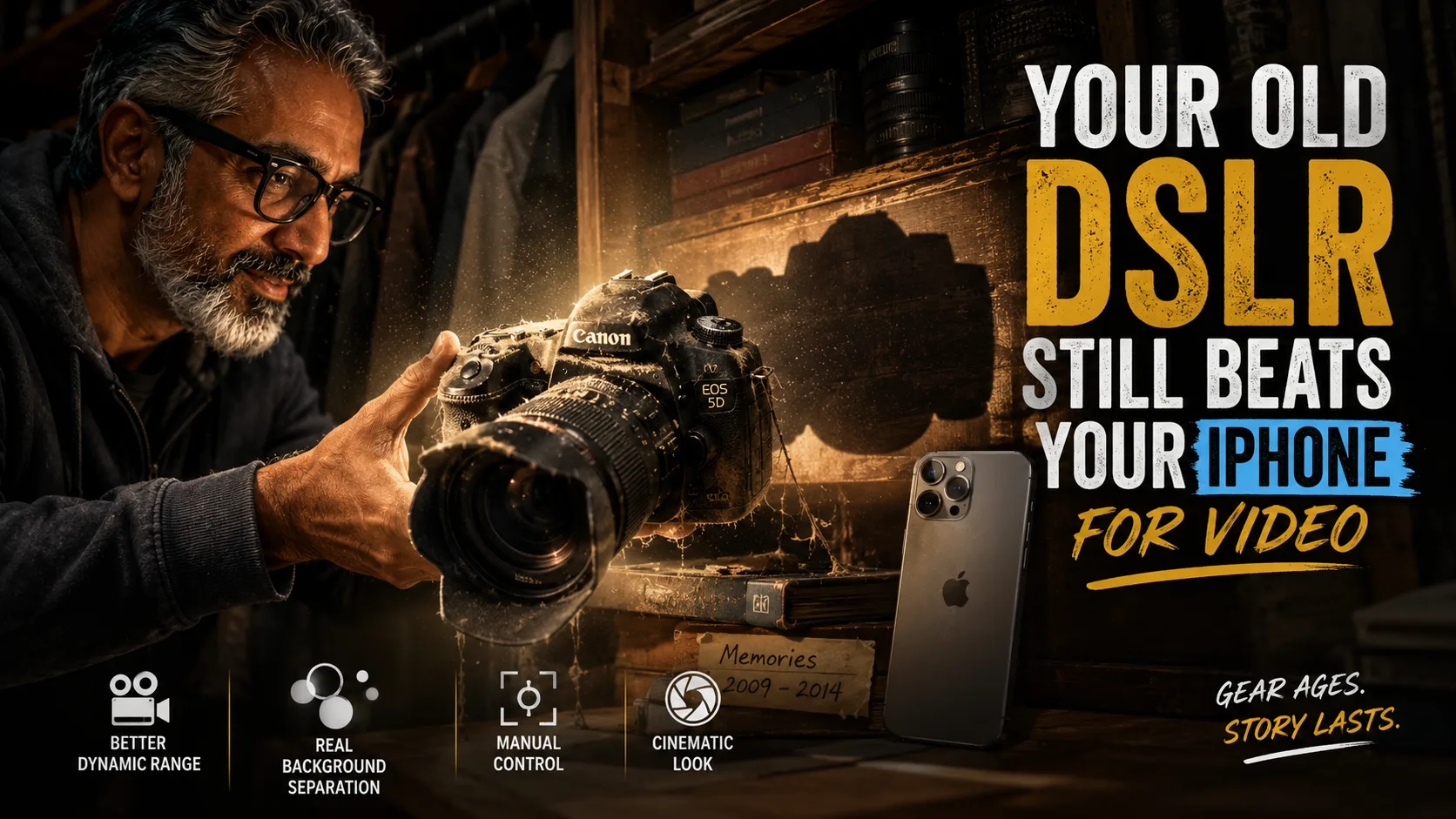
I was on a discovery call with Yasir Wasi last week. Enterprise architect, 20+ years in technology, building a personal brand through LinkedIn video.
Somewhere in the middle of the call, he mentioned he had a Nikon D90 sitting in his closet. Barely touched in fifteen years. He was planning to just use his iPhone instead.
I told him: pull out the Nikon.
The thing people get wrong about camera quality
Everyone defaults to specs. Megapixels. 4K. The number on the box.
But image quality doesn't come from resolution. It comes from the sensor and the lens. Those two things determine how much light your camera captures, and light is everything.
Your iPhone sensor is roughly 1/3 of an inch across. That's the physical size of the chip capturing the image. A Nikon D90 has an APS-C sensor, about 20 times larger by surface area.
Twenty times.
That size difference is the reason a DSLR looks different. More surface area means more light gathered per frame. More light means less noise. Less noise means a cleaner, more detailed image, especially when your lighting isn't perfect. Which, in most home studios, it isn't.
The lens matters more than people think
The physics of optics are not complicated. A larger lens gathers more light. A higher-quality lens renders detail better. And an interchangeable lens system, like the one on any DSLR, gives you options a smartphone can't touch.
Even the kit lens that came with a Nikon D90 in 2008 is a better optic than what's inside any phone. The phone is doing extraordinary things with software to compensate for the limits of its hardware. But software compensation is not the same thing as optical quality.
You can see the difference when you look closely. Sharp foreground. Clean edges. Accurate color. It doesn't look processed. Because it isn't.
The blurry background question
People ask me about this a lot. They want that look where the subject is sharp and the background falls away.
Smartphones do this with computational photography. Portrait mode. It analyzes the image, guesses where the subject ends and the background begins, and applies a synthetic blur. When it works, it looks okay. When it doesn't, and it often doesn't, around hair, glasses, or complex edges, it looks like a filter. Because it is.
A DSLR with a 50mm lens at a reasonable aperture creates that separation optically. The camera isn't guessing. It's just how lenses work at a certain focal length and distance. The result looks real because it is real.
That's the difference between your viewer thinking "nice setup" and thinking "that's a filter."
The resolution trap
Yasir mentioned 4K. I hear this constantly.
A 720p image from a camera with a large sensor and a good lens will look better than 4K from a phone sensor in a typical home studio. The Nikon D90 shoots 720p. People hear that and think it's a limitation.
It's not.
Resolution is how many pixels you have. Image quality is what each pixel looks like. A clean 720p image with good depth and accurate color beats a noisy, flat 4K image every time: on a LinkedIn feed, on a podcast thumbnail, on a talking-head video that lives or dies by how professional the speaker looks.
Don't chase the number. Chase the image.
The practical setup
Here's what pulling a DSLR out of the closet actually looks like:
Clean the sensor if it's been sitting unused. A can of compressed air handles most of it. Use the kit lens to start. You don't need anything else.
For audio, don't use the camera's built-in mic. Get a cheap lavalier and plug it into your recorder or interface. Audio comes from a dedicated source, always. The camera handles the image.
If you want to use the DSLR as a webcam for Zoom or your recording software, add an HDMI-to-USB capture card. An Elgato Cam Link is around $100. Plug the HDMI out from the camera into the Cam Link, plug the Cam Link into your laptop. Your computer sees it as a camera. Done.
That's the full setup. Sensor, lens, lavalier, capture card. You've got a studio camera.
When the iPhone wins
I'm not anti-iPhone. There's a real case for it.
The phone is always with you. If you want to shoot something quick, a reaction, a story, a behind-the-scenes clip, pull out your phone and go. For casual content, for anything that needs to be done in thirty seconds, the iPhone is the right tool.
But for a dedicated home studio setup? A podcast, a LinkedIn series, a talking-head video you're going to put your name on and publish consistently? The DSLR wins on image quality. Every time. The physics don't change because the phone is newer.
The Yasir moment
Yasir already knew what he should do. He'd been thinking about it. He just needed someone to confirm it was worth the effort.
The call ended with him deciding to pull the Nikon out of the closet.
That camera isn't broken. It's not outdated. It has a large sensor, an interchangeable lens mount, and fifteen years of shelf life that cost it nothing. It's ready.
Sometimes you already have the right tool. It's just waiting for you to decide it's worth using.
If you're putting together a home studio and want a second set of eyes on your setup, camera, lighting, audio, the whole chain, that's something I do. Reach out and we'll figure out what you actually need before you spend anything you don't have to.